
Accessibility is Black History
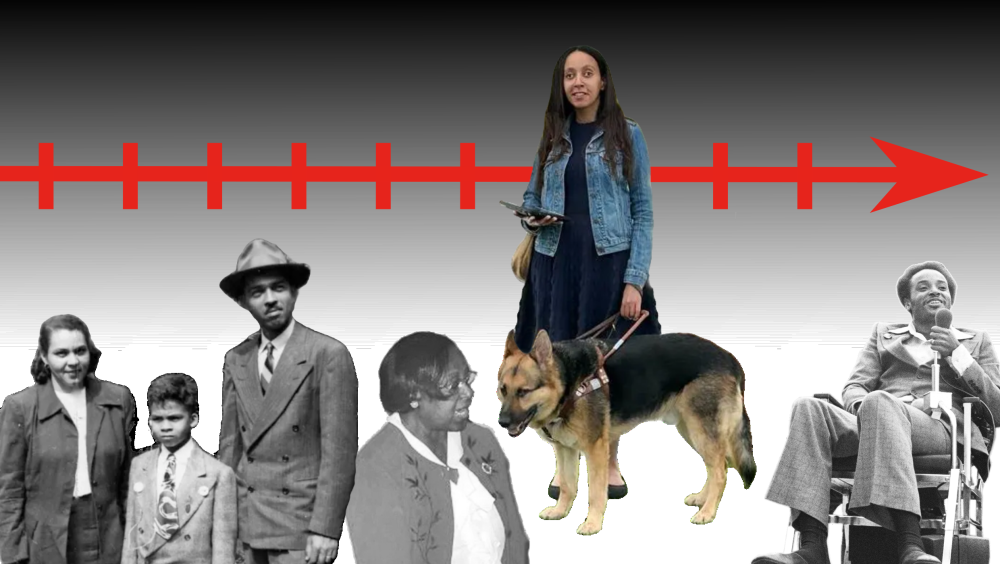
What Haben Girma and a longer lineage of Black advocates teach us about access
Every February, Black History Month prompts a familiar ritual.
Institutions spotlight Black leaders, Black innovation, and Black resilience. In recent years, many of those spotlights have expanded to include Black disabled figures, an important and overdue shift.
But disability history, on its own, is not the full story.
We must talk about accessibility.
Accessibility is not only about bodies. It is about systems. It is about whether people can enter spaces, use tools, access information, and participate fully in public life. And in the U.S., the fight for accessibility has always been inseparable from Black freedom struggles.
To understand that lineage and where it is headed, we need to talk about accessibility as infrastructure, not accommodation.
As civil rights, not charity.
As design, not afterthought.
Few contemporary figures embody that shift more clearly than Haben Girma, a deafblind lawyer, writer, and accessibility consultant whose work spans law, technology, media, and culture.
But Girma’s work does not stand alone. It is part of a longer Black accessibility history one shaped by activists like Brad Lomax, educators like Dr. Sylvia Walker, and legal advocates like Louise B. Miller, who collectively pushed the United States to recognize access as a right.
From Civil Rights to access rights
In 1977, disabled activists staged what would become known as the 504 sit-ins, occupying federal buildings to demand enforcement of Section 504 of the Rehabilitation Act. The law had already been signed. What activists wanted was implementation.
Among them was Brad Lomax, a Black Panther and wheelchair user whose role is often overlooked in disability history narratives. Lomax understood something critical: accessibility was not separate from racial justice. It was deeply connected to housing, policing, healthcare, employment, and state violence. His organizing bridged disability activism and Black liberation movements at a time when those coalitions were rare—and resisted.
Section 504 ultimately became foundational. It prohibited discrimination on the basis of disability in programs receiving federal funding. Today, its scope extends far beyond physical spaces. It applies to digital services, education, media, and technology — domains that increasingly define who gets access to opportunity.
That legal groundwork was strengthened by advocates like Louise B. Miller, whose work helped shape disability law and policy, and Dr. Sylvia Walker, an educator and administrator who fought to expand access within higher education, particularly for disabled students of color.
Together, these figures reframed disability not as an individual deficit, but as a societal responsibility.
That reframing set the stage for a new generation of accessibility leaders — operating not only in courts and classrooms, but in boardrooms, newsrooms, and design labs.
Haben Girma and the shift from compliance to design
Haben Girma is often introduced through a list of firsts: the first deafblind graduate of Harvard Law School, White House Champion of Change, and a MacArthur Fellow. But focusing only on milestones misses the deeper impact of her work.
Girma’s central contribution is not symbolic representation. It is practical translation — between law and technology, disability and innovation, access and excellence.
As she has written and spoken about repeatedly, accessibility is not a constraint on creativity. It is a driver of it.
When apps are designed with accessibility in mind – iMessage, mails or other communication tools – people with disabilities like myself can use them and are able to connect and share information with people,
Girma said at her talk at Apple’s WWDC16.
That philosophy has shaped her consulting work with organizations like The New York Times, Apple, Microsoft, and General Electric. In these spaces, Girma does not argue for accessibility as a moral add-on. She frames it as good design, good journalism, and good business.
When accessibility is built in from the beginning, she argues, everyone benefits — not just disabled users. Captions help people in noisy rooms. Screen reader compatibility improves search and structure. Clear navigation reduces cognitive load. Access scales.
This approach marks a significant evolution from earlier disability advocacy models that centered compliance and retrofitting. Girma pushes institutions to ask a harder question: Who did you imagine when you built this?
Haben Girma’s work insists that accessibility is not a limitation on innovation. It is its foundation.
Accessibility in media: who gets to read the news?
Girma’s work with The New York Times is particularly instructive. Journalism is often framed as a public good, yet many news organizations still publish content that is inaccessible to large portions of the public —whether due to paywalls, poor screen reader compatibility, inaccessible graphics, or video content without captions or transcripts.
Accessibility, in this context, becomes a question of democratic participation.
If disabled readers cannot access news, they are excluded from public discourse. If accessibility is treated as optional or secondary, journalism reproduces the same exclusions it claims to challenge.
By consulting on accessibility practices, Girma helps newsrooms recognize that access is not just technical
It is editorial. It shapes who is informed, who is visible, and whose experiences matter.
That intervention matters deeply during moments like Black History Month, when stories about Black communities circulate widely but are not always accessible to Black disabled readers themselves.
Black accessibility is not a niche story
One reason Black accessibility history remains under-covered is that it sits at an uncomfortable intersection. Disability spaces have often marginalized Black voices. Black history spaces have often sidelined disability.
The result is a narrative gap: Black disabled leaders are either flattened into inspirational figures or erased altogether.
Organizations like the American Association of People with Disabilities (AAPD) briefly touched on this gap — in 2022 — naming Girma as part of its Black (Disabled) History: Past, Present, and Future recognition, AAPD placed her work in a continuum rather than an exception.
That framing matters. Accessibility is not a special-interest issue. It is a structural one. And Black communities — overrepresented among those facing economic barriers, healthcare disparities, and digital divides — have always been disproportionately affected by inaccessible systems.
To talk about accessibility, then, is to talk about power.
Does this article leave you with lingering questions? Did this story change your way of thinking? We want to know.
Innovation that starts with listening
A consistent theme in Girma’s writing is the importance of listening to lived experience. Not tokenizing it. Not extracting it. But designing with it.
Humans are incredibly creative,
Girma wrote in her book, Haben: The deafblind woman who conquered Harvard Law.
We design new ways for each of us to connect and engage and share information.
Too often, accessibility is addressed only after harm occurs — after a lawsuit, after public criticism, after exclusion becomes visible. Girma challenges institutions to reverse that sequence.
Start with disabled users. Start with Black disabled users. Start with those most likely to be excluded.
This principle echoes earlier Black accessibility advocates, even if the language has changed. Brad Lomax organized with those most affected by state neglect. Dr. Sylvia Walker built educational pathways for students historically denied them. Louise B. Miller pushed law to recognize access as enforceable, not aspirational.
Girma carries that legacy into the digital age, where access is increasingly mediated by algorithms, interfaces, and platforms that quietly determine who can participate.
As artificial intelligence, automation, and digital platforms reshape daily life, accessibility risks becoming even more invisible — and more urgent.
If accessibility is not embedded into emerging technologies, exclusion will scale faster than inclusion ever has.
Black History Month offers an opportunity not just to honor past figures, but to ask forward-looking questions: What does access look like now? Who is designing the future? And who is being left out?
Haben Girma’s work insists that accessibility is not a limitation on innovation. It is its foundation.
And Black accessibility history reminds us that progress has never come from waiting politely to be included. It has come from organized pressure, creative resistance, and a refusal to accept systems that only work for some.
Accessibility is Black history. Not because Black disabled people exist — but because Black advocates have consistently expanded the meaning of freedom to include access.
That work is unfinished. But it is ongoing. And it is shaping the world we are all expected to live in.

Akinyele Akintomiwa Michael is a columnist for The Word whose work explores the intersection of technology, accessibility, and storytelling. He focuses on making digital spaces more inclusive while simplifying complex ideas for readers across industries.
This in an opinion. While this piece contains factual information, it is the author’s point of view.
Imagine your logo here
Or here.
Or here.
As a business sponsor of The Word, your logo could be right here. Want to learn more about sponsoring this or other Equal Access Public Media spaces? Email info@equalaccesspublicmedia.org to get the ball rolling.