Inclusive journalism as style
Accessibility is not an afterthought
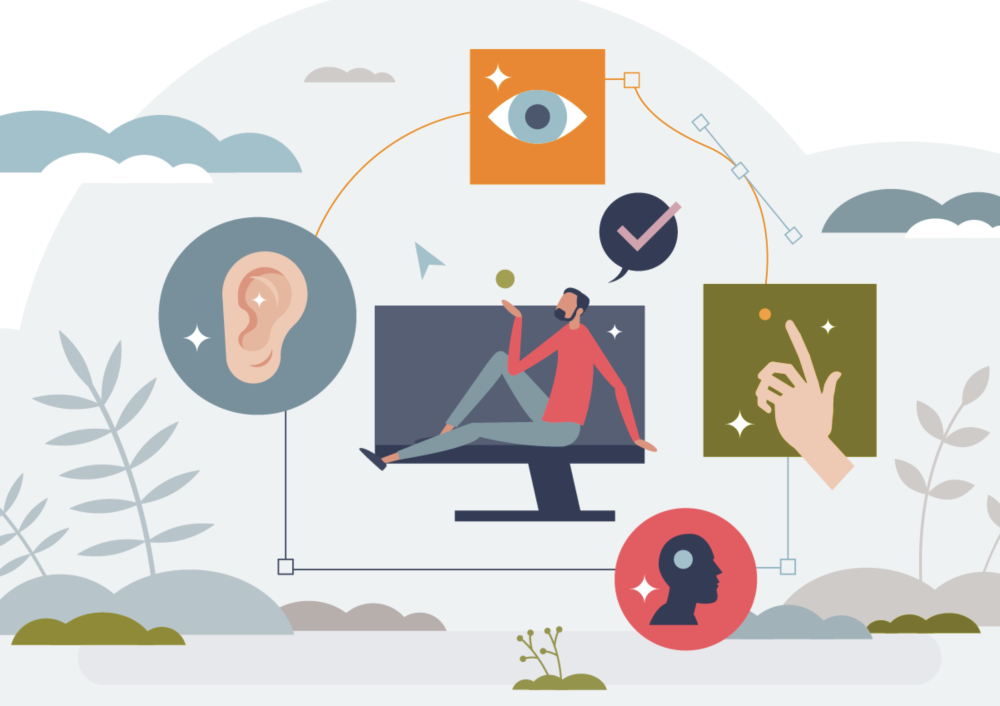
Journalism boasts of telling the truth and representing the general will of the public.
Who is the public when our stories cannot be seen or listened to by everyone?
Media accessibility has been historically viewed as a add-on feature: alt text or captions are afterthoughts, or captions are added in case of a lawsuit situation. Plain language versions are an alternative, not the standard.
The weak point of this approach is that accessibility is not a compliance requirement in many countries. In the U.S., accessibility is enforced by the Americans with Disability Act, but one must sue to enforce that accessibility. Even more stringent online requirements exist in the European Union, but again, it’s enforced by lawsuit.
This translates into whose voices, opinions, and rights we find within our common information spaces.
In this era when newsrooms are vying for diminishing attention and credibility, accessibility is not just an ethical requirement but a style revolution. Accessibility alters the voice, beats, and reach of journalism itself. Accessibility is a component of a soul, if the style of a story is a communicator of soul.
Exposure grows viewership
Accessibility is often thought of as added burden, or something only used by a disabled people — who make up more than a quarter of the population in the U.S. and a approximately one in six people worldwide. Yet the situation is quite the opposite: access increases the audience. Captions are not exclusive to Deaf viewers; they improve the experiences of people in a boisterous cafe, English as a Second Language (ESL) students, and scrollers.
Plain language is not only useful to people with intellectual disabilities but also to those who are drowned in jargon.
Transcribed podcasts can be searched on Google, increasing the reach of news.
The Associated Press Stylebook did not simply rise to the top as style; it provides journalists a common language and standard. A style guide with an accessibility focus like this the EAPM Style and Accessibility Guide can do the same.
Accessibility is not merely an accommodation
The shape of the guide dictates the way journalists write: should we use email or e-mail, climate change or global warming, and disabled people or people with disabilities? These are not insignificant decisions that influence perception and build debate.
However, very little in the way of the mainstream newsroom style manual has taken accessibility as part of style. Rather, it is including accessibility as left to the technical team or a captioning service.
Suppose accessibility were made a style concern from the start. It would involve describing images as carefully as headlines, selecting color patterns when displaying data as carefully as we select fonts, or placing quotations in sources with consideration to neurodiverse readers as we do to grammar rules.
Inclusion is no longer optional when it becomes style. It is visible on the page.
The digital divide in journalism
The spread of digital news storytelling has increased inequality in access. Long-form interactive stories, data visualizations, podcasts, and social videos do not necessitate every individual using computer-generated audio devices, subtitles, or texts. Although certain outlets have accessibility layers, the experience is seldom similar.
Consider the case of the charts in CoVid-19 reporting. Many charts had elaborate color schemes, small fonts, and missing alt text. The greatest public health story of our time was lost to millions of low-vision or blind readers.
Another example, election coverage, features live streams frequently being uploaded without captions, keeping Deaf individuals out of the democratic process. It’s not technical slips but style failures.
Can it be different? Yes.
ProPublica has published searchable transcripts alongside podcasts. The BBC that has been making investments into transcription and audio description throughout its video content. Accessibility just requires choice and newsroom culture.
Between compliance and creativity
Accessibility is frequently narrowed to checklists: WCAG (Web Content Accessibility Guidelines) standards, captioning quotas, and alt text requirements. Although essential, this compliance culture has a tendency to restrain creativity. Suppose, however, that journalists view accessibility as an inventive frontier?
As an example, documentaries can be audio-described as a new art form, using sound effects and voice-over to create pictures in the imaginations of the blind listeners. Transcripts are embraced in podcasts; the transcripts allow a multimedia layer, connecting sources and annotations. In both instances, access is not an burden but an aid to a richer style.
To accessibility-first news
Change cannot be done by individuals only. Newsroom culture must change.
Reporters and editors need to be taught to regard accessibility as inherent in their profession, rather than post hoc. A budget must include captioning and transcription, and not extra.
Guides to style must incorporate accessibility guidelines as well as grammar and punctuation.
It can be done. It is being done. Here it is.
Ishraq Ahmed Hashmi is a freelance journalist and commentator who concentrates on accessibility, media ethics and social justice. His work discusses the way in which inclusive practices can transform journalism and open up the engagement of people. Follow him on LinkedIn at /in/Ishraq-Ahmed-Hashmi.
This in an opinion. While this piece contains factual information, it is the author’s point of view.
Want more of the Word?
Become a Word Patron
Love what you’re reading? Want a to read more? Become a Patron and support The Word for as little as $2.99 a month.