
New tool tracks how media covers trans communities
The Trans News Initiative quantifies and categorizes coverage with data
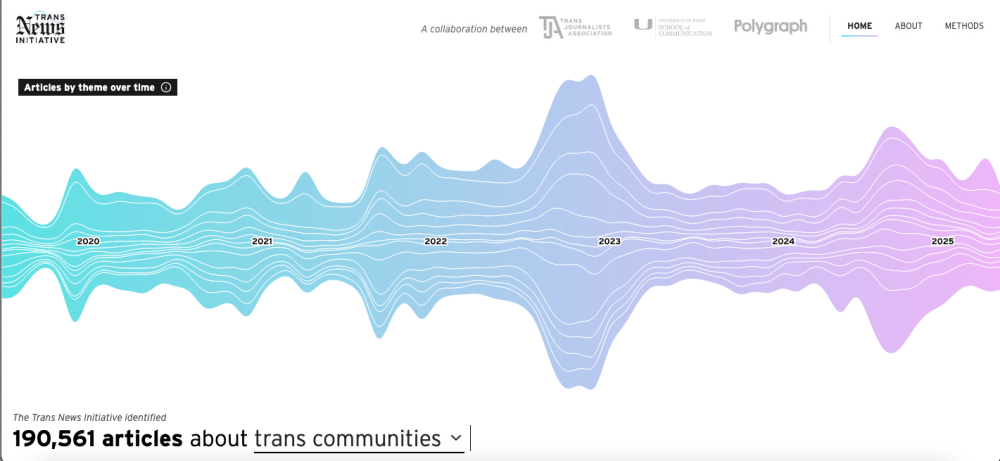
The Transgender Journalists Association (TJA) launched a ground-breaking year-long project which will systematically track and analyze how trans communities are portrayed across U.S. media outlets.
It’s called the Trans News Initiative.
The announcement came during Transgender Awareness Week, underlining the timely and urgent nature of the project.
The TJA is a nonprofit professional membership organization that promotes accurate, nuanced coverage of trans rights and communities in the media, and fosters the careers of gender-expansive journalists. The Trans News Initiative is its largest data-driven project to date.
Designed for journalists, newsrooms, and researchers committed to fair and accurate reporting, the Trans News Initiative draws on a dataset of over 190,000 news articles, categorizing trends in media narratives surrounding trans lives, political attacks, and community issues.
Kae Petrin — co-founder and president of the Trans Journalists Association — said the idea grew from years of observing large-scale patterns in news coverage without having the data to confirm them.
We were seeing these really broad, big-picture trends in what journalists were covering and how we were covering it,
they said. But there wasn’t a lot of work that could actually point to those trends from a data-driven perspective. We wanted something that shows what stories we’re telling — and what we’re not.
The project aims to respond to a media ecosystem in which trans people are often misrepresented, politicized, or quoted less frequently than non-trans commentators in coverage about trans issues. While the tool does not assess the accuracy or quality of reporting, it reveals what topic areas receive the most attention — and which receive little or none. Part of this is helping our industry understand what we’ve focused on, what we haven’t been focusing on, and what stories are missing,
Kae added.
The Trans News Initiative also offers a resource for researchers and media analysts who often struggle to access large, transparent datasets covering coverage of trans issues. The tool makes it possible to explore patterns by time-frame, topic area, and outlet selection, allowing deeper analysis and future research.
Does this article leave you with lingering questions? Did this story change your way of thinking? We want to know.
The project was developed in partnership with Alberto Cairo, the Knight Chair in Visual Journalism at the University of Miami, who funded the initiative and served as a “passionate” advisor throughout its development.
Alberto said the idea began with conversations about how data visualization could test assumptions about media narratives.
I started wondering — are these patterns actually in the data, or is it just my impression?
he said. Visualization lets you see big patterns and exceptions. Once you see the data, your guesses get confirmed — or contradicted.
Originally, the team explored the idea of both a news-coverage tracker and a legislation tracker, but Alberto noted that narrowing the scope made the project achievable within the available time and resources. He also sees broader applications for the tool.
One of my main motivations was to create something that could work as a template for analyzing coverage of other minorities,
he continued. It’s a mirror for the news industry — to see what’s obsessively covered, what’s undercovered, and how those choices shift with political events.
The TJA invites journalists, researchers, and newsrooms to engage with the tracker, use its resources, and strive for more accountable and nuanced reporting.
Beth McCowen is a freelance journalist who specializes in women’s health and sport. Her work seeks to alter how individual journalists and the media as a whole approach and raise awareness of issues.
This is news. This article uses interviews with people whose experiences, lives, or expertise are relevant to a topic along with facts and research to tell a story about an issue.