Designing for everyone
How local and independent outlets are quietly redefining accessible, inclusive journalism
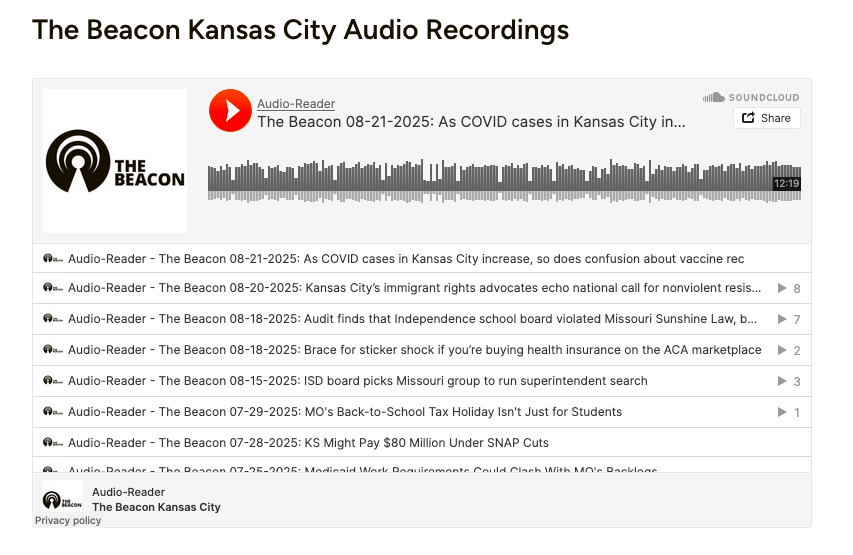
The Beacon, a nonprofit newsroom covering the Kansas City region, Missouri politics, and Kansas Politics, offers audio versions of articles through a partnership with Kansas University Audio Reader. Audio Reader uses a network of trained volunteers to read newspapers, books, magazines, and other print material who are blind, have low vision, or who are print disabled in any way, throughout Kansas and western Missouri. The audio can be obtained on the air, over the internet, by telephone and via smartspeakers 24 hours a day free of charge.
Small newsrooms are proving that accessibility starts with intention, not resources.
At its core, journalism is about connection telling stories that help people understand their world and feel part of it.
Across local communities and digital niches, independent journalism outlets are embracing accessibility as both an ethical and practical cornerstone of their work. They simplify language, write clear headlines, and ensure that every image, video, and graphic is usable by all readers not just the most literate or tech-savvy.
A 2024 Reuters Institute report notes that accessible design practices such as alt text, plain language, and transcripts “build audience trust through clarity.” When newsrooms design for understanding rather than complexity, they widen their reach and deepen connection.
Accessibility consultant Patrick Garvin puts it simply: You can’t fully communicate with your audience if you’re leaving out a big part of your audience. Accessibility is journalism’s job, not an add-on.
Building Accessibility Into Everyday Workflows
For independent outlets, accessibility isn’t a checklist — it’s a mindset and part of the day-to-day operations.
In Canada, The Narwhal, an independent environmental publication, integrates accessibility into every story cycle.
Reporters use plain language to explain scientific terms and include detailed visual descriptions in captions.
We put a big emphasis on our visuals on our website, and we include lots of photography,
said The Narwhal director of audience Arik Ligeti.
For The Narwhal, accessibility isn’t just compliance, it’s credibility.
We have a process to make sure that we’re putting in all text descriptions that are actually helpful or informative for people that rely on those text descriptions,
Ligeti added.
In Kansas City, The Beacon, a nonprofit newsroom partnered with Audio-Reader, a service for people who are blind or visually impaired, to produce audio versions of their stories. Each article on their site now includes an audio player at the top, allowing readers to listen instead of read.
Their editors describe the project as part of a public mission: An inclusive Midwest news ecosystem must eliminate the inequity people face when trying to get information about their community.
Does this article leave you with lingering questions? Did this story change your way of thinking? We want to know.
This partnership demonstrates that accessibility doesn’t require expensive software, just intention and collaboration. A simple community newsroom became a model of accessible storytelling.
At the Sahan Journal, which serves immigrant and refugee communities in Minnesota, accessibility begins with language. The newsroom publishes stories in English but supplements them with community radio partnerships, multilingual explainers, and simplified summaries to reach audiences with different literacy levels or language backgrounds.
During its COVID-19 coverage, Sahan Journal ensured every infographic included alt text, met color-contrast standards, and used culturally clear — not just literal — translations.
Learning From Social Media’s Accessibility Revolution
Social media has accelerated accessibility awareness for small and independent newsrooms who are promoting on places like Bluesky and using newsletter platforms to reach audiences. Platforms like TikTok and Instagram have normalized captions, alt text, and high-contrast visuals tools many independent journalists now use intuitively.
Alexa Heinrich, accessibility expert and author of Accessible Social, described why Bluesky, which has seen a rise in active users who identify as journalists, especially from small and independent outlets, over the last year has helped with accessibility.
The platform has a feature in its settings where users can turn on an alt text reminder. When it’s activated, users are required to add alt text to all images before publishing a post,
she said.
Once the alt text reminder is activated on Bluesky, there is no option to ignore it, thus making alt text mandatory because the user made that choice. And it’s paying off with an increase in awareness of a simple accessibility fix.
Independent creators are taking accessibility into their own hands, writing captions, designing readable graphics, and treating accessibility as craft, not convenience.
But, Heinrich added, if more platforms took the approach that old Twitter did and created dedicated accessibility teams for features, settings, and user experience, accessibility best practices like alt text and captions would be more of the norm for digital professionals and everyday social media users alike.
Akinyele Akintomiwa Michael is a freelance journalist and content writer whose work explores the intersection of technology, accessibility, and storytelling. He focuses on making digital spaces more inclusive while simplifying complex ideas for readers across industries.
This is news. This article uses interviews with people whose experiences, lives, or expertise are relevant to a topic along with facts and research to tell a story about an issue.