
When a lie is a lie
Why newsrooms hesitate to call it out — and what’s at stake
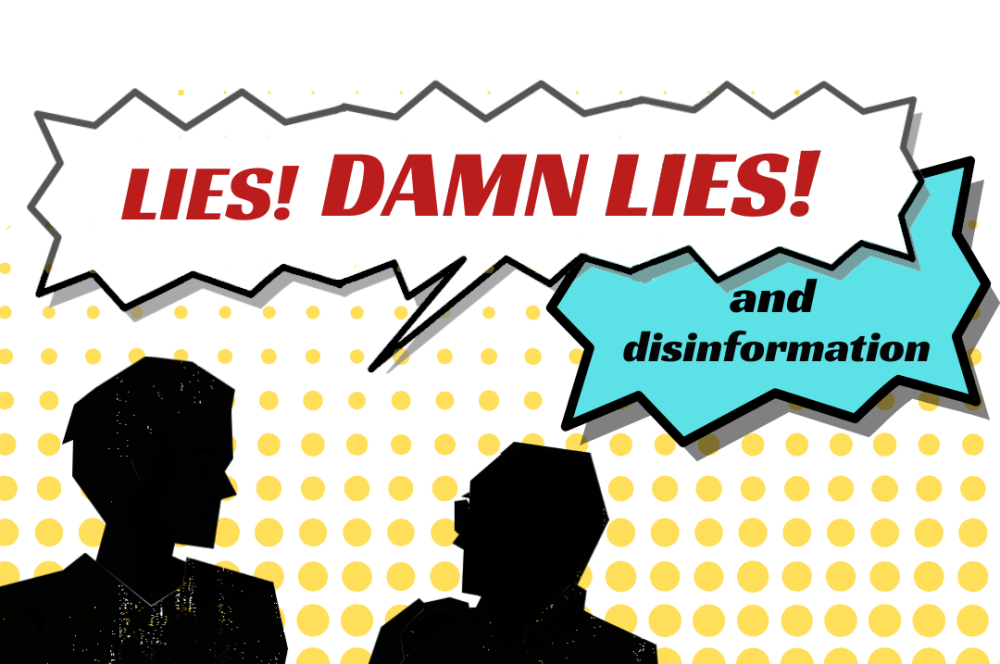
In an era saturated with lies, misinformation and disinformation, the question is no longer whether politicians and public figures lie? The real tension is journalistic: When should reporters directly call out a lie?
Despite overwhelming evidence of lies in public discourse, explicit labeling is rare.
Most newsroom copy avoids the word entirely, opting for softer phrases such as false claim,
incorrect statement,
or unverified allegation.
But as disinformation campaigns grow more sophisticated, the stakes around clarity and accountability rise.
Lies, misinformation, and disinformation
To understand when it’s appropriate to call something a lie, newsrooms must first agree on the definitions that separate mistakes from intentional deception.
A lie is a statement that is both false and knowingly false, delivered with the intent to deceive. A lie begs the question of intent, which is very difficult to judge,
said Chris Lester, interim editor-in-chief at The Beacon, a paper covering Kansas City in Kansas and Missouri.
Journalists are advised against restating falsehoods in headlines, as this can unintentionally amplify the misinformation. The Center for Journalism Ethics puts this plainly: Don’t restate falsehoods in headlines.
The Oxford English Dictionary defines a lie as a false statement made with deliberate intent to deceive.
The key elements are:
- The speaker knows it’s untrue.
- The speaker intends for others to believe it.
This is why journalists hesitate: proving intention is often more challenging than proving falsity.
The Harvard Kennedy School’s Misinformation Review describes misinformation as false or misleading information shared without an intent to deceive.
This can include:
- honest mistakes;
- and misinterpretations.
Rumors shared in good faith Misinformation can still cause massive harm — but the intention is uncertain or absent.
According to the European Commission’s Code of Practice on Disinformation (2022), disinformation is verifiably false or misleading information that is created, presented, and disseminated for economic gain or to intentionally deceive the public.
Disinformation differs from ordinary lies because:
- It is strategic;
- It is often organized.
It can involve coordinated campaigns, bots, agency operations, or political apparatuses This category includes fabricated documents, manipulated videos, deepfakes, and targeted false narratives.
Does this article leave you with lingering questions? Did this story change your way of thinking? We want to know.
Why newsrooms rarely use the word lie
Despite these clear definitions, most newsrooms avoid the term lie
except in opinion pieces or fact-checking columns. Several factors explain why:
First, is the challenge of proving intent. To call something a lie, reporters must establish the speaker knew the truth and chose to distort it. Unless there is:
- documentary evidence;
- prior statements contradicting the claim;
- leaked communications;
- and eyewitness accounts.
Intent remains difficult to prove in straight news reporting.
Using the word lie
can be framed as ideological instead of factual, even when evidence is clear. Narrative-based debunks are more effective than simple corrections in de-biasing beliefs. Explaining why something is wrong is more effective than simply stating that it is untrue, according to the Center for Journalism Ethics.
Some outlets tread carefully to avoid defamation lawsuits. Labeling a statement false
is usually safe; labeling it a lie
introduces an argument about the speaker’s state of mind.
Finally, the traditional newsroom style values restraint. Reporters describe what happened and let readers interpret intention. Many editors view the word lie
as editorializing.
One of my recurring thoughts in recent months is that there are too many opinions and not enough facts in circulation,
Lester said. In that environment, labeling a lie sounds like just another opinion, he added, so at The Beacon, we focus on facts.
When journalists should call out a lie
There are moments when failing to call a lie a lie can cause more harm than good. Based on standards from fact-checking organizations such as PolitiFact, AP Fact Check, and Poynter’s International Fact-Checking Network, there are three conditions where journalists can — and arguably should — use the word.
First, consider if evidence shows clear prior knowledge of the falsehood. If documents, testimony, or prior statements from the speaker show they knew the truth, the intent threshold is met. Examples include:
- internal memos contradicting public statements;
- private communications showing awareness;
- and previously corrected false claims later repeated.
Second, when the claim has been repeatedly debunked, it is a lie. When a public figure repeatedly shares a false statement after it has been corrected, the intent becomes evident. Repetition after correction is a classic indicator of deliberate deception.
Third, a statement may be called a lie or disinformation when the statement is part of a documented disinformation strategy. If a claim aligns with:
- known propaganda campaigns;
- and coordinated online manipulation;
- or previously identified political messaging tactics ;
then calling it a lie is not editorializing — it’s accurate labeling.
The role of transparency
If newsrooms choose to use lie
more frequently, transparency becomes essential. Outlets must explain why they used that label, citing:
- the false claim;
- the evidence contradicting it;
- and proof of prior knowledge;
- and the reason the word
lie
is warranted.
This protects credibility and strengthens trust by showing the decision wasn’t emotional or editorial but evidence-based.
When the evidence supports it, calling a lie a lie is not advocacy — it’s accuracy.
Akinyele Akintomiwa Michael is a freelance journalist and content writer whose work explores the intersection of technology, accessibility, and storytelling. He focuses on making digital spaces more inclusive while simplifying complex ideas for readers across industries.
This is analysis. It looks at a situation or trend through facts, figures, public reactions, and expert response.