
NICAR26 kicks off IRE’s 50th anniversary year
Accountability journalism still matters in an age of AI
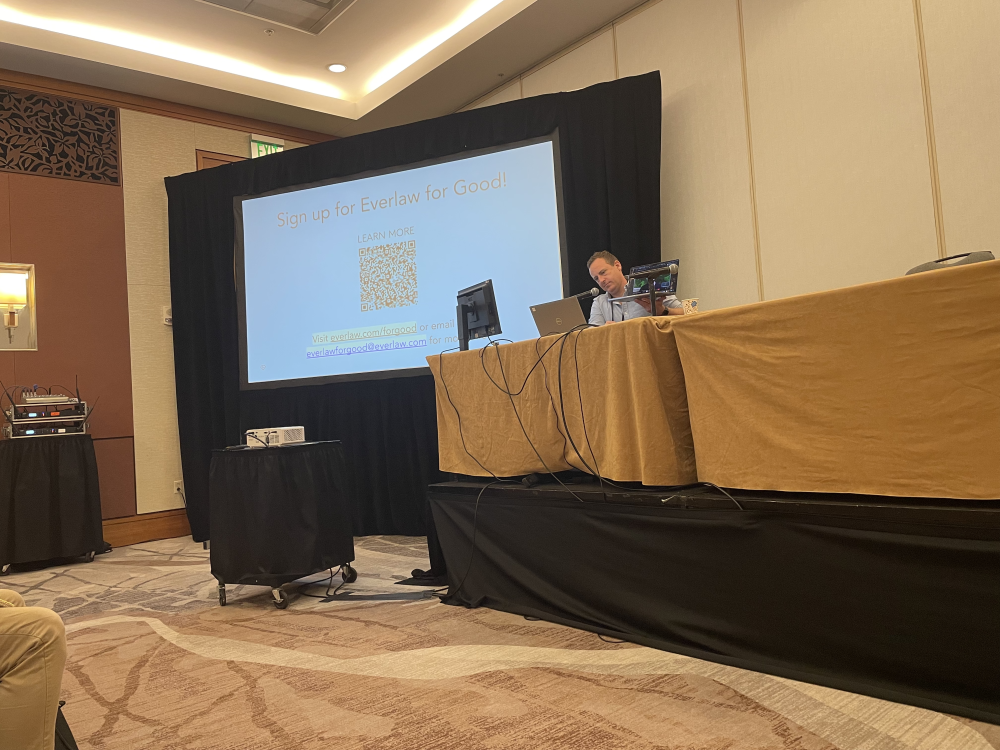
Chris Miles from Everlaw presents “Finding a needle in a haystack: How to manage document-heavy investigations” at NICAR26 in Indianapolis. The session demonstrated how to use Everlaws tools to search documents.
The first time the investigative reporters came together under the umbrella of the Investigative Reporters and Editors in 1976 in Indianapolis, Ind., they were acting in response to pressure.
Reporters came under fire because of keeping power to account, money trails, and demanding that people had a right to know the way the government operated.
Half a century later, such urgency comes around once again.
The first conference of the year for Investigative Reporters and Editors (IRE), the National Institute of Computer-Assisted Reporting — better known as NICAR — begins today where it all started: in Indianapolis.
Although the tools have been developed to be room-size mainframes, to laptops, cloud systems, and artificial intelligence, the main mission has not changed.
Shine a light on the truth. Hold the powerful to account,
said Diana Fuentes, executive director of IRE. Keep the people informed about what their government is doing and how officials are spending the public’s money.
From mainframes to machine learning
NICAR was formed in 1989 with the support of the University of Missouri School of Journalism when journalists started applying data processing to enhance investigations. Fuentes described the aim to bring data journalism out of the university laboratories and into the newsrooms — to office desktops and then laptops before coming to smartphones.
That evolution is on full display at NICAR26.
The conference, which runs through March 8, features over 200 sessions, most of which will be practical, with the most recent tools and techniques in the field of data journalism. Some of the most popular issues are QGIS mapping, analysis of satellite images, Google Earth Engine, and Copernicus browser.
This data visualization continues to be one of the primary attractions to reporters, who are increasingly producing their visuals with readily available applications, a change that brings creative liberation, but also editorial liability.
Artificial intelligence sits squarely at the center of this year’s program.
AI is the backbone of many good tools, but ethics are an essential consideration,
Fuentes said.
NICAR26 will include sessions on both the promise and the risks of AI, including a class on auditing algorithms for bias using AI tools themselves.The other burning concern is verification. With increasingly more difficult to perceive digitally altered images and deep fake videos, journalists are being pressured to verify all they post.
No journalist can responsibly publish a story without verifying every word and every image,
Fuentes said. Your credibility is on the line, and the public is counting on you to get it right.
Accessibility as a core principle
If technology is one pillar of NICAR26, accessibility is another — and organizers emphasize it is not an afterthought.
Accessibility isn’t a privilege, it’s a right,
Fuentes said. NICAR has a history of providing accommodations such as sign-language interpreters, hearing devices, and guides for blind participants, along with gender-neutral restrooms and family rooms.
But accessibility at NICAR26 extends beyond logistics.
Doing accessibility right should also mean making the conference itself workable for people,
said Emilia Ruzicka, an independent data journalist and designer leading accessibility sessions this year. That includes elevators, nearby food, and the ability to take breaks and recharge.
Ruzicka hopes accessibility will surface across the conference, not only in sessions explicitly labeled as such. They have previously addressed accessibility in panels on data visualization and LGBTQ+ inclusion, reflecting how deeply access issues intersect with journalism practice.
Accessibility is applicable to a broad range of discussions that happen at NICAR,
they said.
Does this article leave you with lingering questions? Did this story change your way of thinking? We want to know.
Serving people, not platforms
At a moment when journalism is increasingly shaped by automation, platforms, and performance metrics, NICAR26 is making a deliberate argument about priorities.
Journalism is and always has been about people,
Ruzicka said. Accessibility is central to allowing all people to engage with and benefit from journalism. We don’t do journalism to serve technology. We do journalism to serve people.
That philosophy runs through NICAR26’s programming — from AI ethics and algorithmic accountability to inclusive design and community-centered data reporting
NICAR26 matters now more than ever
NICAR26 comes at a time when journalism is challenged by the convergent forces of declining trust, accelerating technology, shrinking newsrooms, and a new wave of assault on press freedom. The survival instinct may drive one to pursue all new tools as lifelines.
Rather, NICAR is doing the reverse on its 50th anniversary.
Faster code and smarter algorithms are not the only way that data journalism can evolve into the future. It is credibility, verification and access. It is creating systems that are not abandoning audiences. It is recalling that there can be no accountability journalism without the people being able to see it, comprehend it and believe it.
Fifty years after the first congregation of investigative reporters to protect the purpose of journalism in Indianapolis, NICAR26 seems to offer the work that is yet to be done not to redefine journalism but to renew its mission, more fully equipped and more open.

Hashim Quraishi is a reporter and writer from Kashmir. He covers nonprofit organizations who support journalists and journalism for The Word.
Quraishi’s work often explores conflict, memory, and power through a deeply thoughtful and critical lens. As a keen observer and reflective thinker, he writes to uncover the stories that are often silenced — amplifying voices from the margins and challenging how the world remembers.
To read more of his work, connect with him on Medium at @hashimquraishi24.
This is news. This article uses interviews with people whose experiences, lives, or expertise are relevant to a topic along with facts and research to tell a story about an issue.