
Accessibility problems hide inside AI-generated websites
The annual WebAIM Million report shows an overall backslide, but slight progress for news sites
AI can now build a website in minutes.
A prompt, a click, and you have a homepage, a layout, and working code. Tools from companies like Wix, Squarespace, and newer AI-native platforms are making this process faster than ever. Even code assistants like GitHub Copilot can generate entire front-end components on demand.
For startups, creators, and newsrooms under pressure, this feels like a breakthrough.
But something important is getting lost in that speed: accessibility.
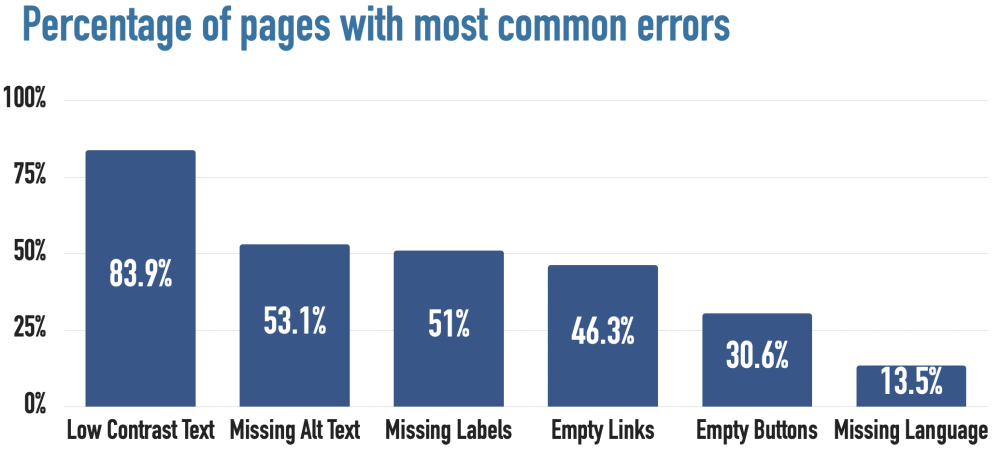
Source: WebAIM Million 2026
In the WebAIM Million annual review of sites, the most common error was low contrast text, found on 83.9 percent of pages, followed by:
- missing alt text, found on 53.1 percent of pages;
- missing labels, found on 51 percent of pages;
- empty links, found on 46.3 percent of pages;
- empty buttons, found on 30.6 percent of pages;
- and missing language, found on 13.5 percent of pages.
What benchmarks are starting to reveal
The annual WebAIM Million report, which analyzes the top one million homepages, consistently finds widespread accessibility failures. In the 2026 latest report released March 30, more than 95 percent of websites had detectable WCAG violations.
A review of 79,157 homepages in the News/Information/Weather category showed a slight improvement since the 2025 WebAIM Million report. In 2026, the report found an average of 59.2 errors — a 5.5 percent improvement since 2025 when it found an average of 59.8 error for the News/Information/Weather category. But the accessibility progress slowed significantly since previous years. Between 2024 and 2025, the category showed a 17.4 percent improvement in the average number of errors and between 2024 and 2024, there was a 22.3 percent improvement.
Common issues across all categories included:
- missing or meaningless alt text;
- poor heading hierarchy;
- low color contrast;
- broken keyboard navigation;
- and incorrect use of semantic HTML.
These are not isolated bugs. They are patterns.
And that’s the concern: AI is replicating existing accessibility failures, and doing it at scale.
Accessibility improvements in news
Average number of accessibility errors on scanned News/Information/Weather homepages from the WebAIM Million reports 2020 to 2026
| Year | Ave. number of errors | Percent changed |
|---|---|---|
| 2026 | 59.2 | 5.5 |
| 2025 | 59.8 | 17.4 |
| 2024 | 69.5 | 22.3 |
| 2023 | 63.8 | 27.5 |
| 2022 | 66.9 | 31.6 |
| 2021 | 66.9 | 43.1 |
| 2020 | 112.4 |
Accessibility is not optional
Web accessibility is what makes the internet usable for people with disabilities, visual, motor, auditory, or cognitive.
The global standard is the Web Content Accessibility Guidelines (WCAG) by the World Wide Web Consortium, which outline how websites should be structured and designed to remain usable for everyone
This includes:
- text alternatives for images;
- clear semantic structure;
- sufficient color contrast;
- keyboard navigability;
- and compatibility with assistive technologies.
These are not edge requirements. According to the World Health Organization, over 1 billion people, about 15 percent of the world’s population, live with some form of disability.
AI doesn’t understand what it builds
At a surface level, AI-generated interfaces often look polished. Layouts are clean. Components are consistent.
AI-generated sites are not escaping the trends seen in the WebAIM Million survey trend. In many cases, they are reproducing it.
That’s because accessibility depends on structure, intent, and user context.
AI systems like OpenAI’s models or other large language models are trained on vast datasets of existing code and design patterns. They learn what is common — not necessarily what is correct.
If accessible practices are inconsistent in the training data, the output will reflect that.
In simple terms: AI predicts patterns. It does not understand users.
It doesn’t test with screen readers.
It doesn’t navigate with a keyboard.
It doesn’t recognize exclusion.
It generates what looks right.
The human shortcut problem
The issue is not just technical. It’s behavioral.
AI changes how people build.
Instead of writing from scratch, developers generate and modify.
Instead of reviewing deeply, they often trust the output.
Accessibility, which already tends to be overlooked, becomes even easier to skip.
This is especially visible in fast-moving environments like startups and digital media, where speed is prioritized.
The result is predictable: faster websites, weaker standards.
Real and uneven impact
When accessibility fails, it doesn’t fail equally.
A visually impaired user may not be able to navigate a page at all.
A keyboard-only user may get stuck in an interface.
A screen reader may interpret content in the wrong order or not at all.
This is not a marginal issue. It is a usability failure affecting millions.
And because these issues are often invisible to those not affected, they persist quietly.
Accessibility is no longer just ethical, it is enforceable.
In the United States, the Americans with Disabilities Act (ADA) has been used in thousands of digital accessibility lawsuits.
High-profile cases, such as Robles v. Domino’s Pizza, have reinforced that websites and apps must be accessible
Other regions, including the EU with the European Accessibility Act, are moving in the same direction.
AI does not remove this responsibility. If anything, it complicates it.
Because when inaccessible code is generated automatically, accountability still falls on the publisher.
Without structured testing, accessibility issues remain hidden behind good design.
Common accessibility benchmarks measure real usability, not just visual output; expose consistent failure patterns; and provide a baseline for improving AI systems.
They shift the conversation from assumption to evidence.
And once something is measurable, it becomes harder to ignore.
AI is not the problem: blind trust is.
AI can support accessibility. It can suggest better patterns. It can flag issues. But it does not do this reliably by default. Accessibility still requires human judgment.
It requires testing, validation, and intent. Right now, that step is often skipped.
If AI is shaping how websites are built, then accessibility must be part of that process.
That means:
- evaluating AI tools on accessibility, not just speed;
- treating AI output as a draft, not a final product;
- integrating accessibility checks into workflows;
- and using benchmarks to hold systems accountable;
because the risk is not just bad design. The risk is scaling exclusion.
AI is lowering the barrier to building websites. But it is also lowering the barrier to publishing inaccessible ones.
If the web is going to be built faster, it also needs to be built better.
Otherwise, we are not just automating work. We are automating mistakes.
Does this article leave you with lingering questions? Did this story change your way of thinking? We want to know.

Akinyele Akintomiwa Michael is a columnist for The Word whose work explores the intersection of technology, accessibility, and storytelling. He focuses on making digital spaces more inclusive while simplifying complex ideas for readers across industries.
This is analysis. It looks at a situation or trend through facts, figures, public reactions, and expert response.
Bring back The Word
The Word is currently suspended due to funding — but you can change that.
Your donations matter. We report on accessibility in the journalism industry. In fact, The Word is the only magazine focused on accessibility in the journalism industry.
Whether you’re a reporter, editor, an accessibility professional, or a member of the public who happens to be interested in journalism or accessibility, we need your help to start publishing again. We don’t hide behind paywalls. We don’t ask you to subscribe. We just ask that you support us.
We’ll keep looking for grants and underwriting, but your donations do matter too.
Help The Word by using the donation box below.