The voices of journalism
College radio opens the path to reporting for aspiring disabled reporters
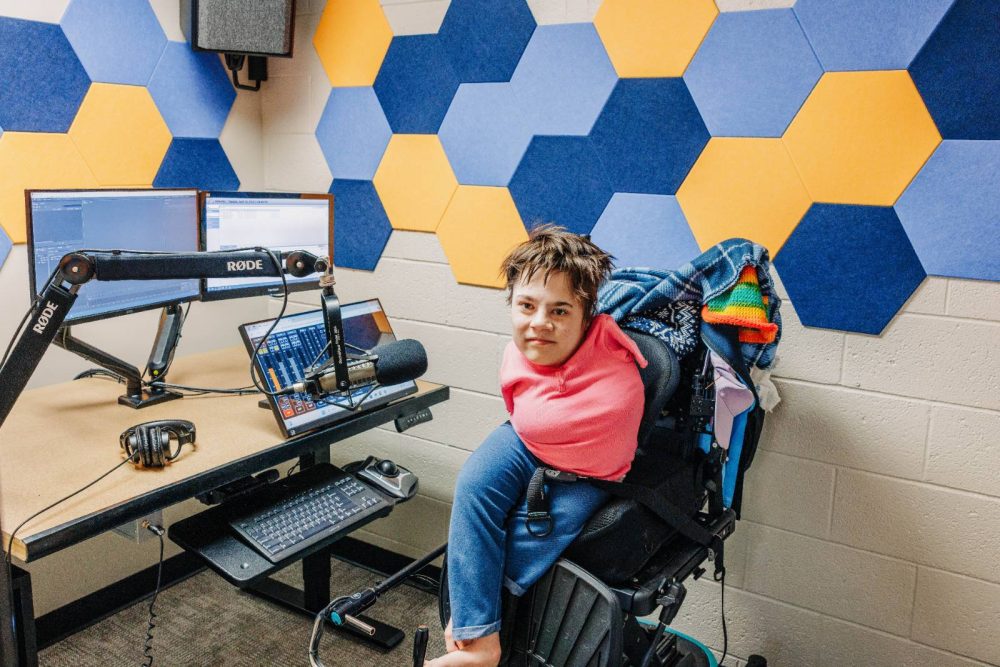
Photo courtesy of Spring Arbor University
Cayley Fehr, a sophomore in Communication Studies at Spring Arbor University in Michigan, was born without arms. She uses her feet to work in an adaptive audio studio at the student radio station Home.fm as a producer.
In a media industry that often prides itself on openness, the path into journalism can still feel closed to many.
For students navigating disability, cost, or cultural barriers, breaking into a newsroom is rarely straightforward. But in the background — far from the spotlight — college radio has long been doing something quietly radical: offering a way in.
This isn’t just about creativity or experimentation. For many, it’s about access.
Audio strips journalism down to its essentials—voice, curiosity, and the ability to listen. And in doing so, it removes many of the barriers that have historically kept people out.
If the studio is accessible or the recording equipment is adapted, the disabled student can create a story like a nondisabled student,
said Beth Haller, a professor emerita of journalism at Towson University and a leading scholar on disability representation in media. Haller is also a co-founder of the Global Alliance for Disability in Media and Entertainment. No vehicle is needed and they don’t have to face inaccessible spaces because they can record from where they live.
Access, on different terms
Traditional reporting often assumes mobility — being able to travel, navigate unfamiliar spaces, and work within rigid environments. For many disabled students, those expectations can turn into barriers.
Audio changes that.
Podcasting offers disabled students an excellent way to learn how to conduct interviews about a variety of topics,
Haller said. Good interviewing skills are a must, and I would hope if a disabled student’s clips are good, they would be welcomed into any newsroom.
That flexibility matters. It shifts the focus from physical presence to storytelling itself.
But access isn’t only about tools or infrastructure. It’s also about who feels welcome.
Sadly, there are still a lot of negative attitudes about disability among journalism faculty at universities,
Haller said. On the other hand, nondisabled students seem to care about treating disabled students fairly… Changing people’s attitudes takes a lot of work.
In many ways, the biggest barriers in journalism today aren’t physical — they’re cultural.
When access is built in
Some college programs are beginning to recognize that accessibility isn’t something to add later — it has to be built into the system from the start.
At Spring Arbor University in Michigan, a student-run radio station recently launched an adaptive studio designed for students with disabilities. The space has already made a difference for students like Cayley Fehr, a communication studies major born without arms, who now operates radio equipment independently using adaptive technology—something that previously required assistance.
For Cayley, that shift has been transformative. This studio means that I have a place at SAU Radio where I can pursue this passion for broadcasting without having someone help me 24/7.
Cayley said, in a story published by Spring Arbor University, adding that what once felt out of reach now feels possible.
Before, I may have struggled to be able to ever do anything radio-related, but now I see it’s possible for me to work the equipment and pursue this.
It’s a small step, but it signals a larger shift — one where access is intentional, not incidental.
Rethinking who journalism is for
For decades, journalism has leaned toward a model of the do-it-all
reporter—someone who can write, shoot, report, and move seamlessly through any environment.
But that model doesn’t work for everyone. And it doesn’t have to.
Editors and reporters need to realize that disabled people can work in the job they trained for,
Haller said. They need not be an expert in all journalism jobs… they should be accommodated and given a chance.
College radio offers exactly that kind of space — a place where students can build specific skills, find their voice, and enter journalism on their own terms.
A quieter way in
For journalists working in audio, this isn’t a new idea — it’s something they’ve seen up close.
For Meghan Smith, an award-winning Senior Digital Producer on the Equity and Justice who focuses on accessibility and disability in her reporting for Boston’s GBH News with a long history in radio, the accessibility of audio storytelling is a key feature.
The ability to conduct interviews and produce stories from a distance, she says, means reporters can focus on listening and story-telling, rather than dealing with some of the logistical challenges of reporting. This can be particularly important for journalists with disabilities or other limitations.
She also notes that audio and podcasting has opened doors for those who might not take a typical career path into journalism. The different path to entry mean aspiring journalists can start their own operations, gaining experience, skills and confidence to work independently of traditional routes. This leads to a greater diversity of viewpoints in the field — even if other inequities remain.
In this way, college radio doesn’t just educate journalists. It’s also shifting the notion of who should be one.
In a media still struggling to become more diverse, the solutions may not be through large changes or new laws. They may come from quieter places — from college radio, makeshift studios, and seldom-heard voices.
Not louder. Just finally heard.
Does this article leave you with lingering questions? Did this story change your way of thinking? We want to know.

Hashim Quraishi is a reporter and writer from Kashmir. He covers nonprofit organizations who support journalists and journalism for The Word.
Quraishi’s work often explores conflict, memory, and power through a deeply thoughtful and critical lens. As a keen observer and reflective thinker, he writes to uncover the stories that are often silenced — amplifying voices from the margins and challenging how the world remembers.
To read more of his work, connect with him on Medium at @hashimquraishi24.
This is news. This article uses interviews with people whose experiences, lives, or expertise are relevant to a topic along with facts and research to tell a story about an issue.
Help keep The Word free to all
The Word is the only magazine focused on accessibility in the journalism industry.
Our publishing organization, the Organization for Accessible Journalism, made a promise from day one that content like this would always be free and never hidden behind paywalls because information is education for the public.
Whether you’re a reporter, editor, an accessibility professional, or a member of the public who happens to be interested in journalism or accessibility, we need your help to keep publishing.
Help The Word by using the donation box below.